 Skip-the-line available
The history of Mary King's Close
From 1500s merchants and the 1645 plague to the building that buried a street beneath the Royal Mile.
Mary King's Close is a street that never quite disappeared. In the 1600s it was a crowded lane running down from the Royal Mile, lined with homes and shops. In the 1750s much of it was cut down and built over, and today it survives beneath the City Chambers, reached on a guided tour. Its story takes in merchants and maids, a widow who gave the close her name, a plague that tore through the Old Town, and a saw maker who was the last to leave. Here's how it fits together, drawn from the operator's own research and the public record.
What a close is
Edinburgh's Old Town sits on a ridge, with the Royal Mile running along its top. A close is a narrow lane falling away from that ridge, and the closes were where people lived. Mary King's Close was one of them, a steep lane of houses and shops running down from the main street, with neighbours living on top of one another.
Space inside the town was tight. In the 17th century, Edinburgh's tenements rose as high as 10 to 12 storeys, packed closely together inside the city's Flodden Wall. Very little natural light reached the narrow closes below, and lanterns were an everyday necessity for getting around. The operator's guides talk about residents who ranged from the richest of the rich to the poorest of the poor.
Mary King's Close is recorded as the close that ran nearest the Nor Loch, a polluted marsh that once lay beside the Old Town. The operator describes it as Edinburgh's only preserved 17th-century underground street. It is completely separate from the South Bridge vaults, a different site that visitors sometimes confuse it with.
It helps to picture the close as a street rather than a cellar. It was a lane lined with homes and shops, with tall buildings rising on either side and neighbours above and below. What survives of it now lies beneath later buildings and is reached from the Royal Mile, which is why a visit feels like going underground, even though you're walking down an old public street.
The 1500s: merchants, maids and Gardyloo
One of the guide characters you can meet on the tour comes from 1535. Agnes Chambers is a household maid serving Alexander Cant, a merchant burgess, in his house on Craig's Close. In the operator's telling, her life is about to take a dramatic turn when a murder happens in that house. Her character takes great care over her master's quaich collection and looks forward to getting home after a long day.
Agnes also brings with her the best-known phrase of Old Town life. Between 10pm and 7am, slops were thrown out into the closes, and the warning cry before they went was 'Gardyloo'. Agnes dislikes those hours, which is easy to understand for anyone who had to walk the lanes at night.
The point of these characters is that they're based on real people. The operator says each costumed guide portrays a former resident who really lived, worked and died on the closes of the Old Town. Agnes's master, a merchant burgess with a house and servants, shows the kind of household that lived just off the Royal Mile in the 1500s, long before the street took Mary King's name.
If Agnes leads your tour, her story frames the close through the eyes of a servant rather than a merchant. That shift matters. The operator says its guides share the stories of residents from the richest of the rich to the poorest of the poor, and a maid's view of a merchant's house shows how closely those lives sat together on the same narrow lane.
Mary King, the woman behind the name
Mary King was born in Edinburgh towards the end of the 16th century, the daughter of Alexander King and Jonet King. In August 1616 she married Thomas Nimmo, and the couple had four children: Alexander, Euphame, Jonet and William. By the 1630s she was a widow, raising those four children and running a business of her own.
She made and sold fine cloth, from a shop on the High Street, and she was a burgess in her own right, with voting rights in the city. The operator describes her as a prominent businesswoman of the 1630s, and points out that having a close named after a woman reflects the standing she had in the town.
Before Mary arrived in 1635, the lane was known as King's Close or Alexander King's Close. She lived there with her children in later life, and the street eventually took her name. Mary King died in late 1644, the year before the worst plague outbreak in Edinburgh's history. The close's souvenir guidebook includes an augmented-reality feature in which a Mary King character explains what it meant to be a burgess.
Her story matters because she wasn't a figure of legend. She was a working parent and trader whose name stuck to a street. Her marriage is recorded in Edinburgh's parish records, and her standing as a burgess with voting rights in the city tells you a good deal about her position. When you stand on the close today, you're standing on the lane she lived on.
The plague of 1645
In 1645 Edinburgh suffered the worst outbreak of plague in its history. The operator explains that the crowded living conditions of the Old Town closes let sickness spread rapidly through the homes of their residents. Narrow lanes, tall buildings, little light and families living close together gave the disease every chance to move from house to house.
Two of the tour's guide characters come from this year. Walter King was head of Edinburgh's 'foul clengers', the workers who cleansed the homes of people who had been infected. The operator calls him an often overlooked hero of the epidemic, who risked his life doing the job. His uniform carried a St Andrew's cross, and his character likes the smell of burning and air free of what people then called 'miasma'.
Dr George Rae was a physician who played a pivotal part in what the operator calls the second and most devastating outbreak of plague in Edinburgh. He served the city council and contributed to the emerging medical sciences in the city. His character is candid about one thing: he liked being rewarded handsomely for his vital work.
Together, Walter and George show the ordinary people who risked their lives to treat and clean up after the sick. The plague years are also where legend and record most easily blur, and stories about what happened on the close have grown over time. Our ghost stories guide deals with the legends. Here, the record is enough: a crowded street, a deadly disease, and people who went into infected homes anyway.
Coffee, the Royal Exchange and a buried street
By the 18th century the Old Town was changing. In 1740 the Royal Exchange Coffee House, run by Mary Ogle, stood above Mary King's Close and was a favourite with locals. The coffee cart at the attraction today is named after her, one of several small links between the site and the people who once lived and traded around it.
In 1753 the town commissioned a large new building on the Royal Mile, the Royal Exchange, designed by the architect John Adam. It opened in 1760, opened by the Lord Provost, George Drummond. The works absorbed several of the closes that ran down from the High Street, and Mary King's Close was among them.
The new building didn't sweep the closes away completely. The Exchange was built partly on top of their truncated buildings, which were later blocked off. Mary King's Close was partly demolished and partly buried during the construction. What was buried, rather than cleared, is the reason a 17th-century street still survives beneath the Royal Mile today.
Life above carried on. One of the guide characters belongs to this later period. Robert Fergusson, a well-known poet and a literary inspiration to Robert Burns, is portrayed in 1771, when the notorious Cape Club was in full swing. His character loves debate and visits to the Royal Exchange Coffee House on Craig's Close, a place for talk and argument. The operator hints that tragedy isn't far away for him.
The City Chambers and the last resident
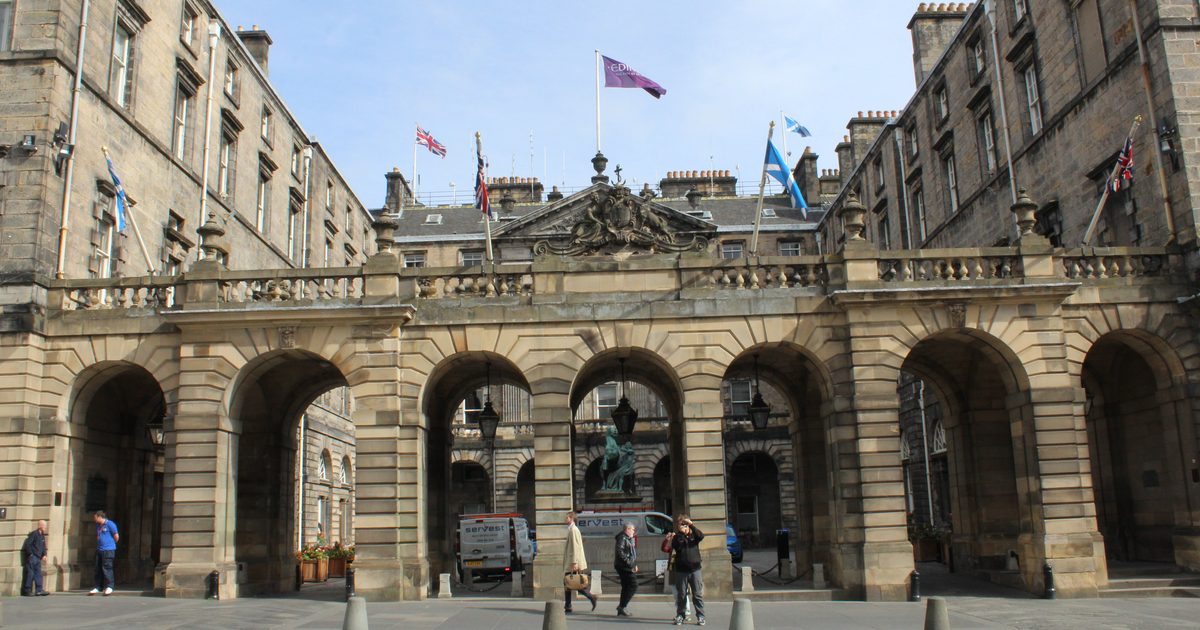
In 1811 the Town Council took over the north range of the Royal Exchange as the City Chambers. That's the building you'll see on the Royal Mile today. The entrance to the tour sits right next to its flags and arches, so you start your visit beside the very building that covered the close.
People went on living in what remained of the close for a long time. The operator's last resident is Andrew Chesney, a saw maker, whose story it dates to 1897. In the operator's account, he was compelled to leave his lodgings to make way for the expansion of the Royal Exchange building. Other accounts differ on exactly when he finally left, so 1897 here is the operator's date.
His character is one of the more human ones on the tour. He's proud of his lion-head door knocker and his very own 'thunderbox', and he's not at all happy about having to say goodbye to his home. He's also unimpressed by customers who don't pay. He's a reminder that the close wasn't simply abandoned when the Exchange went up. People lived here into the late 1800s.
Seen together, the dates give the story its shape. A busy lane in the 1500s and 1600s, struck by plague in 1645, cut down and built over from 1753, taken into the City Chambers building from 1811, and finally left by its last resident at the end of the 1800s. The tour walks through what remains of all those layers at once.
The close today
Today the close can only be seen on a guided tour. Tours start at the Admissions Office on the Royal Mile, at 2 Warriston's Close, opposite St Giles' Cathedral and the Mercat Cross, and then descend into the streets below. Your guide leads you through more than 400 years of history as you walk through former homes and shops that were once full of activity and trade.
The guides are the costumed characters described above, among them Agnes Chambers, Walter King, Dr George Rae, Robert Fergusson and Andrew Chesney. Each tour is led by one of them, telling the close's story from their own point in time. That's why the operator says no two tours are quite the same. Whoever leads yours, you'll find out who Mary King was and hear about the plague along the way.
The tour lasts about an hour, involves steep stairs and uneven floors, and isn't open to children under 5. Children aged 5 to 15 must be with an adult. If you'd like to go, we book the tour time you choose and your e-ticket comes by email. Book ahead, as the operator says the close frequently sells out. Our tickets guide explains how the tour times work.
The history above is the backbone of the tour, but each guide adds the detail of their own era. A tour with the plague doctor will feel different from one with the maid of 1535 or the saw maker of 1897. The operator pitches it at return visitors as well as first-timers for exactly that reason, so a second visit with a different guide can still feel fresh.
Frequently asked
Who was Mary King?
A cloth merchant and a burgess in her own right. Born in Edinburgh in the late 1500s, she married Thomas Nimmo in 1616, was a widow raising four children by the 1630s, and arrived on the close in 1635. She died in late 1644.
What was Mary King's Close called before?
King's Close or Alexander King's Close. According to the operator, that was the lane's name before Mary King arrived in 1635. It later took her name.
Why is Mary King's Close underground?
Because a building was put on top of it. The Royal Exchange, commissioned in 1753 and designed by John Adam, was built partly over the truncated buildings of several closes. Mary King's Close was partly demolished and buried, and survives beneath what became the City Chambers.
Who was the last resident of Mary King's Close?
Andrew Chesney, a saw maker. The operator dates his story to 1897, when he was compelled to leave to make way for the expansion of the Royal Exchange building. He is one of the characters the costumed guides portray.
Is Mary King's Close the same as the South Bridge vaults?
No. They are completely separate sites. The operator describes Mary King's Close as Edinburgh's only preserved 17th-century underground street, beneath the Royal Mile.
Are the tour guides based on real people?
Yes. Each costumed guide portrays a former resident who really lived, worked and died on the closes, such as the maid Agnes Chambers in 1535 or Walter King, head of the foul clengers during the 1645 plague.